Global Standards In Ultra Luxury Apartments: How Hyderabad Competes Internationally
Luxury apartments used to mean bigger rooms and nicer marble. That was enough once. Now, the idea feels different somehow. People compare homes across cities and even across countries without thinking twice. A family might look at homes in Singapore, Dubai, and then suddenly at international standard luxury apartments in Hyderabad in the same evening. It’s not strange anymore. What stands out is how expectations have shifted. Height matters now. Privacy matters more. Services matter in ways they didn’t before. A building isn’t just a building; it’s supposed to feel like a complete environment. Somewhere along the way, homes started trying to feel like hotels, and residents began expecting that. In Hyderabad, this shift is visible in pockets where towers rise a little taller and look a little more deliberate. The change didn’t happen all at once. It came slowly, and then suddenly it felt normal.
What Makes Something Feel International
It’s actually harder to define than expected. International doesn’t always mean flashy. Sometimes it just means thoughtful planning that avoids obvious compromises. High ceilings make a difference in a way photos can’t explain. Large balconies stop feeling decorative and start feeling usable. Elevators become faster and quieter. Even corridors become wider, though people rarely notice until they walk through them. These details show up again and again in global luxury residential projects in India, almost like a shared language between cities. Someone who has lived abroad tends to notice these things first. The spacing between towers, the number of apartments per floor, the way light enters a room, these details quietly signal whether something feels global or not. Sometimes it’s less about luxury and more about restraint. Not everything needs decoration, not every surface needs shine.
Why The Financial District Feels Different
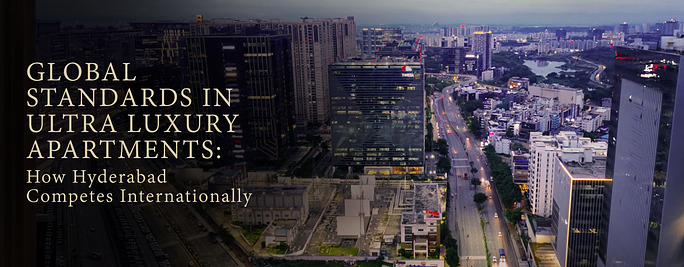
The Financial District has a certain energy that’s hard to ignore. Offices came first, then restaurants, then homes followed naturally. It feels planned, even if it wasn’t entirely. The rise of Financial District premium residences makes sense in that context. People working nearby often want homes that match the pace of their work lives. Long commutes start feeling unnecessary once towers begin appearing closer to offices. There’s also a sense that this part of the city looks outward. Companies here deal with global clients, and that influence spills into architecture and expectations. Developers seem to understand that buyers here often compare properties internationally before deciding. That comparison changes everything quietly. We chose the Financial District for Skyline because it connects directly to Hyderabad’s fastest-growing business hubs, placing our residences within easy reach of HITEC City, Gachibowli, and the ORR. At Skyline by Candeur, we see this location as part of daily convenience, not just a pin on the map.
Height And Space Mean Something Again
Tall buildings used to be rare enough to feel special on their own. Now height alone isn’t enough. What matters is how that height is used. Apartments that occupy entire floors feel different from shared corridors. Privacy becomes part of the architecture rather than an added feature. It’s one of the reasons ultra luxury real estate in Hyderabad often focuses on fewer units rather than more. Space inside apartments has also changed. Large living areas are expected, but so are service spaces and storage. Even balconies have grown into something closer to outdoor rooms. These details sound small individually, but together they shape how a home feels day after day.
Amenities That Try To Keep Up
Amenities have become almost competitive. Every project tries to offer something slightly better or slightly newer. Some succeed, some don’t. What seems to matter most is whether the spaces feel usable. A large clubhouse sounds impressive, but it needs to feel welcoming. Wellness spaces need natural light. Quiet corners need to actually feel quiet. The best world-class luxury flats in Hyderabad seem to understand this balance. They offer variety without overwhelming residents with choices. It’s less about quantity and more about how naturally these spaces fit into daily life. That’s harder to design than it sounds.
Where Skyline Fits Into This Shift
We at Skyline have watched these expectations evolve closely. The idea was never just to build taller, but to build with intention. One sky villa per floor changes how privacy feels, not just how it sounds in a brochure. When homes range from 6,520 to nearly 12,000 square feet, the challenge becomes making that space feel comfortable rather than overwhelming. The location in the Financial District connects daily life to the city’s busiest corridors without pulling residents into the noise. With only a limited number of residences rising across 59 floors, the goal has always been simple: create homes that feel rare without trying too hard to prove it.
The City Is Still Catching Up To Itself
It sometimes feels like Hyderabad is still adjusting to its own growth. Towers rise quickly, but the idea of living in them takes longer to settle in people’s minds. Buyers often hesitate at first. Then they visit enough properties to see patterns forming. They begin noticing similarities between local projects and international ones. Eventually, the comparison stops feeling ambitious and starts feeling practical. That shift says something about where the city stands now. The feeling is less about catching up and more about finding its own version of luxury.
Final Thoughts
Luxury homes used to be defined by what they had. Now they’re defined by how they feel over time. That’s a quieter way of thinking about it, but it seems more accurate. Hyderabad’s luxury apartments aren’t trying to copy global cities exactly. They’re adapting ideas and reshaping them for local life. The results feel familiar in some ways and completely new in others. What’s becoming clear is that the gap between cities has narrowed. Buyers expect more, and developers respond. Somewhere in that exchange, a new standard forms. And once people get used to that standard, it becomes the new normal.
 Click here for map